
REF. 0584
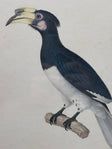
Anthracoceros albirostris (Calao pie)
Condition report
The piece is held for you for 7 days, with no immediate payment — choose the “Reservation” method at the payment step.
The piece is held for you for 7 days, with no immediate payment — choose the “Reservation” method at the payment step.
The piece is held for you for 7 days, with no immediate payment — choose the “Reservation” method at the payment step.
NICOLAS HUET (Paris, 1770–1828).
Anthracoceros albirostris (Calao pie) [formerly Buceros convexus in Temminck]
Watercolour, gouache and gum arabic over graphite.
29 x 23.5 cm
Signed
Engraved in Temminck and Laugier, Nouveau recueil de planches coloriées d’Oiseaux, pour servir de suite et de complément aux planches enluminées de Buffon, Paris, 1838, vol. II, part I, pl. 530.
Nicolas Huet, the eldest of the three sons of the painter Jean-Baptiste Huet (1745–1811), was born in Paris in 1770. From an early age, Huet "the Younger" trained under his father before being appointed in 1804 as a draughtsman at the Muséum d'Histoire Naturelle in Paris. The works of Huet the Younger, and in particular his drawings of insects, quadrupeds and birds, are among the most esteemed in the museum's collection. During his long career at the museum, where he worked until the end of his life, Huet produced more than 200 drawings on vellum depicting animals and shells for great collectors, notably the Empress Joséphine, the Prince d'Essling, and Frederick Augustus II, King of Saxony.
In 1822, Huet was appointed to the chair of iconography at the Muséum, a post previously held by the Dutch artist Gérard van Spaendonck.
The work by Coenraad Jacob Temminck (1778–1858) and Baron Meiffren Laugier de Chartrouse (1772–1843) was intended as a sequel and complement to the plates of Georges-Louis Leclerc, Comte de Buffon (1707–1788), who published a monumental Histoire Naturelle, générale et particulière in 36 quarto volumes between 1749 and 1788.
"Il est facile de confondre ce Calao inédit avec l'espèce très répandue, depuis longtemps connue et décrite dans les catalogues méthodiques sous le nom de Buceros malabaricus, dont Le Vaillant a donné une bonne figure, et qu'il nomme Calao à bec blanc." (Temminck)


1 / 3
Ask a question about this piece
REF. 0584 — Anthracoceros albirostris (Calao pie)