
REF. 0840
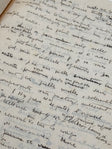
Autograph manuscript "Mémoire pour le cours des Hauts Etudes"

Condition report
The piece is held for you for 7 days, with no immediate payment — choose the “Reservation” method at the payment step.
The piece is held for you for 7 days, with no immediate payment — choose the “Reservation” method at the payment step.
The piece is held for you for 7 days, with no immediate payment — choose the “Reservation” method at the payment step.
CÉLINE, Louis-Ferdinand. Autograph manuscript "Mémoire pour le cours des Hautes Etudes". N.p., n.d., [1932].
Quarto (278 x 233 mm). 18½ pages.
Red leather binding.
A striking autograph draft — sibling and contemporary of Voyage au bout de la nuit, whose verve it shares — in which Céline turns a scholarly commission into a misanthropic pamphlet: a heavily struck-through, unfinished first draft that demolishes the bureaucratic stupidity of official Hygiene, the better to demand, against « hommes moins bien soignés que les cochons », a hygiene at last « fraternelle » in the service of « hommes réels ».
Written probably in 1932, on the occasion of the planned creation of an Institut des Hautes Études d'Hygiène, this Mémoire pour le cours des Hautes Études remained unpublished at the time; it was gathered only much later in the Cahiers Céline 3. The manuscript presented here is a first draft of it, incomplete (18½ pages), covered with deletions, interlinear additions and second thoughts: a working document in its raw state, in which one grasps the Célinian sentence in the act of forming.
The date is crucial: we are at the moment when Voyage au bout de la nuit appears (October 1932), and this text bears all its marks. The tone is no longer that of an administrative report: it is that of the pamphlet — sentences punctuated with ellipses, a familiar and slangy register (« on s'en fout », « couillons », « jemenfoutisme », « gagas savants et débiles mentaux administratifs »), and that misanthropy shot through with fraternity which is the very signature of Bardamu.
The argument unfolds in two stages. Céline begins with a methodical demolition of hygiene as it is taught and practised: a field « où le niveau spéculatif est si bas, la critique absolument inexistante », peopled with a « cohorte… méprisable et presque nauséeuse » of « philanthropes, fonctionnaires et professeurs » who « cumulent les emplois où on bave et où on signe ». Criticism, he says, « réussit donc à tous les coups »: « c'est un véritable jeu de massacre ». Official hygiene is merely a « muraille d'impossibilités » backed by « la tartuferie monstrueuse des gros intérêts économiques et par conséquent des pouvoirs publics » — a formula in which, as early as 1932, an explicit political critique can be seen.
But the Mémoire is not only destructive. In it Céline puts forward a positive definition, which forms its core: « L'Hygiène véritable repose sur l'application fraternelle du confort physique, moral, géographique de tous les membres d'une communauté donnée ». And from it he draws a diagnosis of astonishing social acuity: men practise « la fraternité avec ennui » while they give themselves « au pillage et à l'assassinat avec passion et frénésie »; above all, injustice accumulates instead of being corrected — « les mieux protégés sont aussi les plus forts… les plus surmenés sont les moins bien nourris ». The whole rhetorical weapon rests on a systematic zoological debasement — men are by turns « huîtres », « poissons », and finally « beaucoup moins bien soignés que les cochons »: « une porcherie tenue comme une République aurait fait faillite depuis longtemps ».
Full transcription available on request.


1 / 8
Ask a question about this piece
REF. 0840 — Louis-Ferdinand Céline — Autograph manuscript "Mémoire pour le cours des Hauts Etudes"