
REF. 0655
[MANUSCRIPT]. Caton, tragédie angloise de Monsieur Addisson traduite en françois.
Condition report
[MANUSCRIPT]. Caton, tragédie angloise de Monsieur Addisson traduite en françois.
€3 000
The piece is held for you for 7 days, with no immediate payment — choose the “Reservation” method at the payment step.
The piece is held for you for 7 days, with no immediate payment — choose the “Reservation” method at the payment step.
The piece is held for you for 7 days, with no immediate payment — choose the “Reservation” method at the payment step.
[MANUSCRIPT]. Caton, tragédie angloise de Monsieur Addisson traduite en françois.
1749.
4to (230 × 170 mm). 213 pp. Contemporary red morocco, triple gilt fillet borders, spine gilt in compartments with raised bands, gilt turn-ins, gilt edges; a handsome contemporary binding.
A superb mid-eighteenth-century calligraphic manuscript in red morocco.
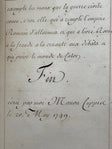
Each leaf is framed within a thin red ruling; the text is written in a regular, elegant brown ink hand, with decorative flourishes on several leaves (notably pp. 182–185 and the final page). Signed at the end: “écrit par mois Manon Cuppire, le 20 May 1749”.
A French translation of Addison’s Cato (1713), the celebrated political and stoic tragedy by Joseph Addison (1672–1719), playwright, essayist, co-founder of the Spectator, and major figure of early British liberal thought. The play enjoyed enormous success in Europe and was praised by Voltaire. Although translated into French by Abel Boyer soon after publication, the present version is independent and does not correspond to any known printed translation.
This manuscript therefore represents an original, otherwise unrecorded translation prepared in 1749.
A very attractive copy on high-quality glazed paper, in a period red morocco binding. Old, unobtrusive waterstain along the lower joint and on the covers.
From the library of Georges Captier.
![[MANUSCRIPT]. Caton, tragédie angloise de Monsieur Addisson traduite en françois.](http://www.librairie-alexisnoque.fr/cdn/shop/files/Image11.jpg?v=1761554954&width=1800)
![[MANUSCRIPT]. Caton, tragédie angloise de Monsieur Addisson traduite en françois.](http://www.librairie-alexisnoque.fr/cdn/shop/files/Image1.jpg?v=1761554954&width=1800)
![[MANUSCRIPT]. Caton, tragédie angloise de Monsieur Addisson traduite en françois.](http://www.librairie-alexisnoque.fr/cdn/shop/files/Image10.jpg?v=1761554954&width=1800)
![[MANUSCRIPT]. Caton, tragédie angloise de Monsieur Addisson traduite en françois.](http://www.librairie-alexisnoque.fr/cdn/shop/files/Image9.jpg?v=1761554953&width=1800)
![[MANUSCRIPT]. Caton, tragédie angloise de Monsieur Addisson traduite en françois.](http://www.librairie-alexisnoque.fr/cdn/shop/files/Image8.jpg?v=1761554954&width=1800)
![[MANUSCRIPT]. Caton, tragédie angloise de Monsieur Addisson traduite en françois.](http://www.librairie-alexisnoque.fr/cdn/shop/files/Image7.jpg?v=1761554954&width=1800)
![[MANUSCRIPT]. Caton, tragédie angloise de Monsieur Addisson traduite en françois.](http://www.librairie-alexisnoque.fr/cdn/shop/files/Image6.jpg?v=1761554953&width=1800)
![[MANUSCRIPT]. Caton, tragédie angloise de Monsieur Addisson traduite en françois.](http://www.librairie-alexisnoque.fr/cdn/shop/files/Image5.jpg?v=1761554954&width=1800)
![[MANUSCRIPT]. Caton, tragédie angloise de Monsieur Addisson traduite en françois.](http://www.librairie-alexisnoque.fr/cdn/shop/files/Image4.jpg?v=1761554954&width=1800)
![[MANUSCRIPT]. Caton, tragédie angloise de Monsieur Addisson traduite en françois.](http://www.librairie-alexisnoque.fr/cdn/shop/files/Image3.jpg?v=1761554954&width=1800)
![[MANUSCRIPT]. Caton, tragédie angloise de Monsieur Addisson traduite en françois.](http://www.librairie-alexisnoque.fr/cdn/shop/files/Image2.jpg?v=1761554954&width=1800)
1 / 11
Ask a question about this piece
REF. 0655 — Manon Cuppire — [MANUSCRIPT]. Caton, tragédie angloise de Monsieur Addisson traduite en françois.