
REF. 0902
Œuvres

Condition report
The piece is held for you for 7 days, with no immediate payment — choose the “Reservation” method at the payment step.
The piece is held for you for 7 days, with no immediate payment — choose the “Reservation” method at the payment step.
The piece is held for you for 7 days, with no immediate payment — choose the “Reservation” method at the payment step.
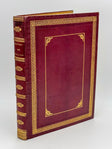
BERNARD, Pierre-Joseph. Œuvres.
Paris: Didot l'Aîné, 1797.
Quarto (310 x 229 mm). (2) ff., XI-300 pp., (1) f.
Parma-violet morocco, gilt roll and fillets, raised bands tooled in blind and gilt, gilt roll to board edges, gilt edges, gilt roll to turn-ins (Simier R. du roi).
Prud’hon’s masterpiece as an illustrator, and one of the finest books to come from the presses of Pierre Didot l’Aîné.
The illustration comprises 4 plates after Pierre-Paul Prud’hon: three for L’Art d’aimer, engraved by Beisson and Copia, and the celebrated Phrosine et Mélidore, etched and engraved by the artist himself, “perhaps the only engraving the master indisputably made” (Cohen). This nocturnal scene, in which Mélidore clasps the unconscious Phrosine as she emerges from the waves, is regarded as the summit of his printed œuvre and as one of the founding images of the pre-Romantic sensibility.
One of 150 copies on heavy Angoulême vellum paper, with the plates before letters, the only ones to contain the opera Castor et Pollux, “which was not joined to the rest of the edition” (Cohen): they run to 300 pages, against 198 for the ordinary issue. This tragédie lyrique, set to music by Rameau (1683–1764), was first performed at the Académie royale de musique on 24 October 1737.
The son of a sculptor from Grenoble, Bernard (1708–1775), the “French Anacreon” whom Voltaire nicknamed Gentil-Bernard, owed to the patronage of Madame de Pompadour his post as librarian of the King’s cabinet at the Château de Choisy.
A superb copy, cited by Cohen, in a binding signed “SIMIER R. DU ROI” at the foot of the spine, a mark the binder used only from 1818 onwards.
From the libraries of Jules Noilly (1886, no. 207); Adrien-Louis Lebeuf de Montgermont (1911, no. 12); Antoine Vautier (1971, no. 5); and Pierre Berès (2007, VI, no. 237).
Cohen, 133–134 and Suppl., 1085 – Sander, 124 – Portalis & Béraldi, III, 358 – Ray, The Art of the French Illustrated Book, no. 75 – Goncourt, Catalogue raisonné de l’œuvre peint, dessiné et gravé de P.-P. Prud’hon, 1876.


1 / 4
Ask a question about this piece
REF. 0902 — Pierre-Joseph Bernard — Œuvres