
REF. 0576
Roland furieux. Poème héroïque

Condition report
The piece is held for you for 7 days, with no immediate payment — choose the “Reservation” method at the payment step.
The piece is held for you for 7 days, with no immediate payment — choose the “Reservation” method at the payment step.
The piece is held for you for 7 days, with no immediate payment — choose the “Reservation” method at the payment step.
ARIOSTE. Roland furieux. Poème héroïque.
Paris, Brunet [t. I-III] et Laporte [t. IV], 1775-1783.
In-4 (268 x 211), 2 tomes en 4 volumes, T1 - (4) ff., 222 pp., (2) ff., T2 - (1) f., 266 pp., T3 - (2) ff., 283 pp., (1) f., T4 - 567 pp., (1) f.
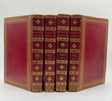
Full morocco, 6 rows of wide roulette around the boards, smooth spine decorated, title and tomaison gilt, roulette on the edges, gilt edges, inner roulette (contemporary binding).
First edition of Louis d'Ussieux's translation.
It is illustrated in the first edition by Cochin with 46 hors-texte figures executed in intaglio by Delaunay, Lingée and Ponce in engraved frames. There are also 7 figures by Moreau, 9 by Cipriani, 2 by Eisen, 2 by Monnet and 21 unsigned. In all, 92 engravings illustrate this famous text from the late eighteenth century, not including the frontispiece portrait in volume I drawn by Titen and executed by Fiquet.
Ariosto's whimsical and fantastic text, a great classic of the Ancien Régime in the same vein as Homer, necessarily called for engravings of the same calibre, which Cochin, more than anyone else, achieved superbly. ‘The engravings, made expressly for this edition, are very beautiful; in some copies the suite of 46 figures from the Italian edition of Baskerville has also been placed, with a new framing; moreover, the figures of chants V and XII are no longer the same: the two former figures, judged not to be very pleasant, have been redrawn with great care by Moreau le jeune (P. 279 and 282); they exist respectively in 4 and 5 states.’ (Cohen).
Small loss to the lower jaw of the first plate of volume IV, jaw of the second plate slightly split, pagination error on page 488 (marked 388) of volume II, otherwise a superb copy in contemporary binding.
Cohen, 97.


1 / 4
Ask a question about this piece
REF. 0576 — Arioste — Roland furieux. Poème héroïque