
REF. 0810
Document signed by Khrushchev, Communist Party of Ukraine to Nikita Khrushchev

Condition report
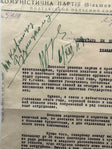
Document signed by Khrushchev, Communist Party of Ukraine to Nikita Khrushchev
€4 500
The piece is held for you for 7 days, with no immediate payment — choose the “Reservation” method at the payment step.
The piece is held for you for 7 days, with no immediate payment — choose the “Reservation” method at the payment step.
The piece is held for you for 7 days, with no immediate payment — choose the “Reservation” method at the payment step.
Nikita KHRUSHCHEV (1894-1971), Document signed with autograph apostille, green ink, on typed document addressed to Khrushchev by the Communist Party of Ukraine, Ukraine, 3 December 1949; letterhead of the Communist Party (Bolshevik) of Ukraine, ink receipt stamp, in Russian.
1page In-folio (300 x 195 mm - frame: 470 x 360 mm).
An extremely rare document from Khrushchev, then First Secretary of the Party in Ukraine since 1937. The letterhead is signed in green ink and Khrushchev has written the names of Comrades Korniyets and Roudnytsky, along with his signature and the date ‘8/XII/49’ (8 December 1949). The Poltava Regional Committee gives a very positive assessment of the rebuilding of livestock stocks since the war, but alerts Khrushchev to the critical situation regarding fodder supplies.
"КОММУНИСТИЧЕСКАЯ ПАРТИЯ (большевиков) УКРАИНЫ
ПОЛТАВСКИЙ ОБЛАСТНОЙ КОМИТЕТ
Секретарю ЦК КП(б)У
товарищу ХРУЩЕВУ Н. С.
Выполняя решения партии и правительства о развитии животноводства, трудящиеся колхозов и совхозов области добились, что в настоящее время количество крупного рогатого скота превосходит уровень довоенного 1940 года, примерно на 35 % или на 90 тыс. голов. Заметно увеличилось поголовье свиней, особенно увеличилось поголовье свиней на откорме в колхозах и совхозах для выполнения этим видом животных государственного плана мясопоставок.
Однако, в связи с неблагоприятными климатическими условиями этого года, кормовой баланс в колхозах и совхозах нашей области очень напряженный и ряд колхозов и совхозов испытывают затруднения.
Большим подспорьем в кормовом балансе является свекловичный жом, но доставка его свеклосеющим колхозам сопряжена с большими трудностями, а для отдаленных от железной дороги колхозов почти невозможна.
Кроме того, сахарному заводу им. Сталина, перерабатывающему до 35 тысяч центнеров свеклы в сутки, подается свекла из ряда районов и колхозов расположенных в противоположном конце области, куда отгрузка свежего жома железнодорожным транспортом затруднена. Вместе с тем, этот завод выпускает большое количество сухого жома, который по нарядам Министерства отгружается за пределы нашей области. Таким образом, если учесть, как количество сухого жома в переводе на свежий жом отгружается за пределы области, плюс необходимое количество жома, которое потребляется для круглогодовой работы пункта государственного откорма скота, то завод не имеет возможности отоварить жомом все колхозы за сданную им свеклу.
Таких сахарных заводов, что вырабатывают сухой жом три: им. Сталина, им. Ильича и Грамковский, которые должны выработать 35 тыс. центнеров сухого жома и отгрузить в другие области, что в переводе на свежий жом составляет около 450 тыс. центнеров."
Translation:
"COMMUNIST PARTY (BOLSHEVIK) OF UKRAINE
POLTAVA REGIONAL COMMITTEE
To the Secretary of the Central Committee of the CP(b) of Ukraine,
Comrade N. S. Khrushchev
In carrying out the decisions of the Party and the Government concerning the development of livestock farming, the workers of the collective farms (kolkhozes) and state farms (sovkhozes) of the region have achieved the result that at the present time the number of head of cattle exceeds the pre-war level of 1940 by approximately 35 per cent, or by 90,000 head. The number of pigs has increased noticeably; in particular, the number of pigs being fattened in the collective and state farms has risen sharply in order to fulfil, with this category of livestock, the State plan for meat deliveries.
However, in view of the unfavourable climatic conditions of this year, the fodder balance in the collective and state farms of our region is very strained, and a number of collective and state farms are experiencing difficulties.
A major contribution to the fodder balance is provided by sugar-beet pulp, but its delivery to the beet-growing collective farms is associated with great difficulties, and for collective farms remote from the railway it is almost impossible.
Moreover, the Stalin Sugar Factory, which processes up to 35,000 centners of beet per day, receives beet from a number of districts and collective farms situated at the opposite end of the region, to which the shipment of fresh pulp by rail transport is difficult. At the same time, this factory produces a large quantity of dried pulp, which, according to the allocations of the Ministry, is shipped beyond the boundaries of our region. Thus, if one takes into account the quantity of dried pulp converted into its equivalent in fresh pulp that is shipped outside the region, plus the necessary quantity of pulp consumed for the year-round operation of the State cattle-fattening station, the factory has no possibility of supplying pulp to all the collective farms in exchange for the beet delivered by them.
There are three such sugar factories producing dried pulp: the Stalin Factory, the Ilyich Factory, and the Gramkov Factory, which are required to produce 35,000 centners of dried pulp and to ship it to other regions, which, when converted into fresh pulp, amounts to approximately 450,000 centners."
In 1949, Khrushchev was one of the main figures responsible for the reconstruction of Soviet agriculture in Ukraine, against a backdrop of chronic shortages and extremely rigid planning. This document illustrates the contradictions of the system in a very concrete way: even as production recovered, the central mechanisms of requisitioning and redistribution caused serious local blockages at the very heart of the post-war Soviet rural economy.
Left edge slightly frayed, otherwise in fine condition for this exceptionally rare document.


1 / 3
Ask a question about this piece
REF. 0810 — Nikita Khrouchtchev — Document signed by Khrushchev, Communist Party of Ukraine to Nikita Khrushchev