
REF. 0945
Essame de gl'ingegni de gl'huomini Per apprender le Scienze : Nel quale, scoprendosi la varietà delle nature, si mostra a che professione sia atto ciascuno, & quanto profitto habbia fatto in effa
Condition report
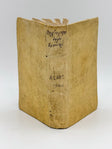
Essame de gl'ingegni de gl'huomini Per apprender le Scienze : Nel quale, scoprendosi la varietà delle nature, si mostra a che professione sia atto ciascuno, & quanto profitto habbia fatto in effa
€1 500
The piece is held for you for 7 days, with no immediate payment — choose the “Reservation” method at the payment step.
The piece is held for you for 7 days, with no immediate payment — choose the “Reservation” method at the payment step.
The piece is held for you for 7 days, with no immediate payment — choose the “Reservation” method at the payment step.
HUARTE DE SAN JUAN, Juan. Essame de gl'ingegni de gl'huomini Per apprender le Scienze : Nel quale, scoprendosi la varietà delle nature, si mostra a che professione sia atto ciascuno, & quanto profitto habbia fatto in effa.
Venice: Alde Manuce, 1590.
Octavo (162 x 114 mm). (8) ff., 367 pp., (8) ff.
Stiff vellum, spine with old inscriptions of the author, the publisher and the date (contemporary binding).
Edition of the Italian translation established by Camillo Camilli.
First published in 1575 under the title Examen de ingenios […], this work by the Spanish physician Juan Huarte de San Juan (1530-1592) is considered the first treatise on differential psychology. Drawing on medical knowledge, examples and an analysis of classical literature, the author elaborates his own model of intelligence and offers practical advice. It represents, according to Garrison-Morton, "the first attempt to demonstrate the link between psychology and physiology."
The copy had been acquired by its previous owner on account of several passages devoted to the game of chess, on pages 123, 240, 242, 253, 257 and 260. Schmid notably quotes, from the German translation: "Le jeu d'échecs montre de la manière la plus évidente la puissance de l'imagination […] Le jeu d'échecs est une représentation de l'art de la guerre." Van der Linde likewise notes this passage: "Pourquoi certains jouent mieux à jeun qu'après avoir mangé, et inversement."
The present edition is the Italian translation established by Camillo Camilli.
Old sound and very faint dampstain from page 14, then 19/20, 31, 41 to 52. Very short contemporary annotation on the title page.
From the library of Lothar Schmid, his ex-libris.
Van der Linde, II, pp. 419 et seq.; Garrison-Morton, 4964; Schmid, p. 199 — references relating in each case to other editions.


1 / 7
Ask a question about this piece
REF. 0945 — Juan Huarte de San Juan — Essame de gl'ingegni de gl'huomini Per apprender le Scienze : Nel quale, scoprendosi la varietà delle nature, si mostra a che professione sia atto ciascuno, & quanto profitto habbia fatto in effa